Showing posts with label fountains. Show all posts

Friday, May 6, 2011

acqua


Water is a common good. In Italy it's a precious public resource. There will soon be a referendum here to vote against (or to ratify) the privatization process of public water. With this post I wish to remind all Italian citizens how important our acqua is, and encourage them to vote at the coming May 12-13 election.

Wednesday, February 23, 2011

studenti alle belle arti


How can you tell these are foreign exchange students?

Their happy smiles and carefree attitude. The sweet life.
(shorts, sleeve lengths and sockless boat shoes in February were a dead giveaway)

Saturday, August 21, 2010

giorno e notte

taken on the same day

Back in the Eternal City.

Wednesday, May 5, 2010

piazza mattei

the turtle fountain


The recently restored Renaissance fountain "of the turtles" was designed by Giocomo della Porta in 1581 and built by the sculptor Thaddeus Landini. The bronze figures are standing on four dolphins. Originally there were to be eight dolphins, but the water pressure was insuffiicent, so only four were installed. With the removal of the four extra dolphins, the upraised hands of the statues seemed to have no purpose.

So perhaps to correct this problem and balance the composition, in 1658 Pope Alexander VII commissioned Gian Lorenzo Bernini or Andrea Sacchi to cast an addition: the turtles.

When in 1979 one of turtles was stolen, the remaining originals were replaced by copies.

I love this piazza. I come here to sit and enjoy the water play, the silence of the adjacent streets. And the nearby Antico Forno bread bakery...


For more Watery Wednesday images, click HERE


Monday, March 1, 2010

formiche

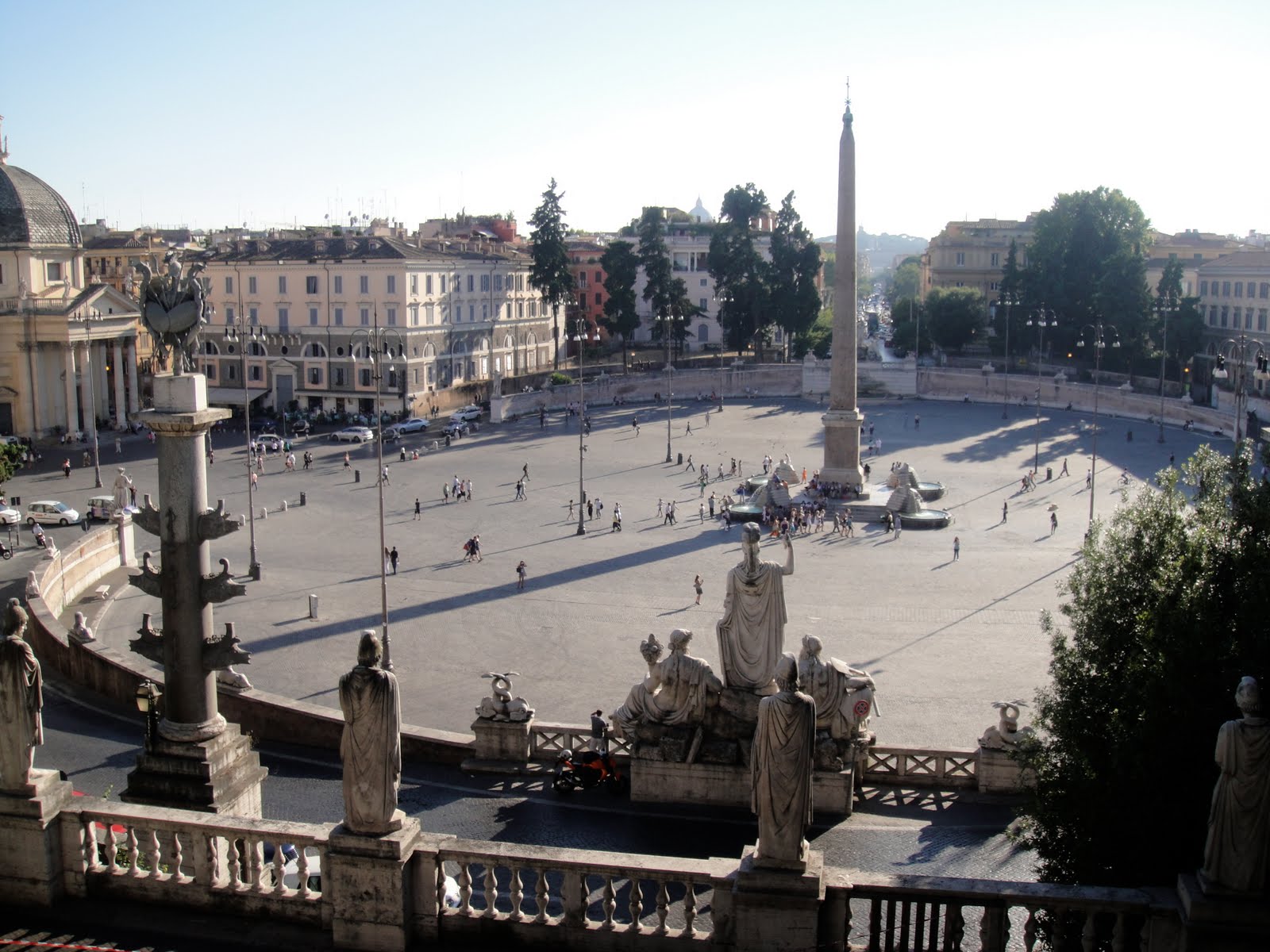
Piazza del Popolo


Unbelievable to think that a few years ago this majestic pededstrian zone was reduced to a parking lot, choked by traffic and chaos. For centuries, the Piazza del Popolo was a place for public executions, the last of which took place in 1826. There are 3 churches in the piazza, and a central fountain with an Egyptian obelisk.
Some big event is being planned, because a huge stage is being built, and there are small gazebos popping up like mushrooms all over the open space.

Saturday, February 13, 2010

dettagli


A papal miter... keys... a fierce looking dolphin... 
which Roman fountain do these elements belong to?


...more hints...


The fountain and obelisk "della Rotonda," in front of the Pantheon, right!


Wednesday, January 20, 2010

fontana dei cavalli marini


Circles and sea horses


How many fountains are there in Rome? A million dollar-question. No other city in the world, I believe, can compete in number of fountains with the Eternal City. Percy Bysshe Shelley–(1792–1822) English poet, and leading figure of the romantic movement famed for his radical political views–observed that, "The fountains alone justify a journey to Rome."
Water and the myriad fountains from which it spills are part of Rome's artistic and cultural heritage and have always been one of the city's prominent characteristics.

The Fontana dei Cavalli Marini, 'fountain of the sea horses,' was designed in 1791 by Cristoforo Unterberger, some say built by Luigi Salimei, others by Vincenzo Pacetti.
It stands in the middle of a round plaza, surrounded by trees and a pedestrian walkway at the Via Pinciana main entrance of Villa Borghese.

My son likes to throw pebbles in the fountain's wide basin, and watch the sun play with the circular ripples in the water.


For more Watery Wednesday images from around the world, click here.


Saturday, December 19, 2009

il leone e l'obelisco

Obelisco Flaminio (13th century B.C.)


Towering at the center of Piazza del Popolo is the Flaminio obelisk native of Heliopolis–one of the most ancient cities of Egypt–where it originally stood across from the Temple of the Sun. Its hieroglyphics spell the name of Pharaoh Ramses II and his son Mineptah, who dedicated the 34-meter monolith to the Sun God Rhà.

The Flaminio obelisk was the first megalith to be imported by the Roman Empire as a decoration for the Circus Maximus in 10 A.D. by Augustus. As the stadium fell in disuse, the obelisks adorning it collapsed and in time were buried under layers of soil as the street level rose. In 1587 the ruins of the circus and the broken obelisk were found, and in 1589 Pope Sixtus V had the monument fully restored and erected in its current location. The four Egyptian-style lions and underlying fountain basins surrounding it were added in 1818.


ShareThis